Assalaamu alaikum everyone! My apologies for this going up a couple days late - as I'm sure you all were doing, I was preparing for Ramadan, and then yesterday I fasted plus had doctors appointments, etc.
So!
Today's Get Ready With Me is Pakistani style, in honor of my largely Pakistani local community (looking at all of my Aunties except my Khala). <3
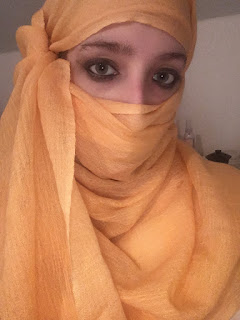
So, the shalwar suit featured in the video was a gift from a Pakistani Auntie who owned a clothing store. It consists of the orange shalwar, a inner liner which can also be used as a plain kameez (as in the beginning of the video), the kameez itself, and the dupatta, shown in the picture above. Cream and orange don't always work well with my skin - I tend to look sickly because it brings out more of my olive tones while also making me look very very pale. So I gave it to my friend Azrah, pictured above. Check out her blog at https:niqabibi.wordpress.com!
For a long time I wondered how my Khala did her niqab in the masjid. I saw other Desi Aunties doing it as well, but could never get it to work for me. Finally I realized whenever I see my Khala do it, her hair is down or a very low bun (she doesn't have long hair like me)! This must be how the other Aunties do it as well, because this is the only way I've gotten it to work. 😅 The style requires you to have you ears showing at first, which is something I've seen other Desi sisters do just with the hijab or dupatta in order to help keep it in place, or as habit.
First take your dupatta or scarf and place it over your head, with one short side and one long side.
Tuck the scarf behind your ears.
Take the long side and, keeping it tucked behind your ear, draw it across your face.
Bring the scarf around the back of your head (as you can see, my hair is NOT in a bun)
Take the extra fabric near your ear and cover your ear with it. (This is optional but I prefer to cover my ears.
Tuck the end of the scarf into the side, next to your ear.
So there we have it! A quick and easy niqab style seen casually in many Desi communities! While it doesn't work for fancier events, it works well in the masjid in order to cover the face when walking through common space or past the men's area.
Ramadan Mubarak to all of my lovely friends and family within my community, and thank you SO MUCH for your support and inspiration and love. May Allah ta'ala bless you and reward you generously and accept all of your ibada during this holy month. Ameen!
Assalaamu alaikum! It's been a while since I've been able to post an actual blog post, but if you are reading this and want to see things I have posted, head over to my YouTube where you'll find tutorials and reviews that I couldn't easily do blog posts on.
Today's look is Bedouin inspired. To hear a bit more about the company from which I received many of the pieces in this look, hop on over to my video bundle review for The Desert Boutique!
The abaya I'm wearing in the photo is actually from Bangladesh. It was a gift from my Muslim family, ma shaa Allah, and while it's not Kuwaiti like the other pieces in this look, the style itself with the thin sleeves is what Mia over at The Desert Boutique described as being worn under the overhead khimar in the picture. The trim also was similar enough to the scarf that I felt it was a good choice! And comfy.
The overhead abaya/khimar is closed-front and comes with an elastic band to help keep it on the head. However, the sides are partially open and the fabric is sheer, so one should at least wear long sleeves and pants under it for modesty purposes. The abaya likely goes to about knee-length on average-sized persons when worn as an overhead, but it can also be worn on the shoulders which will make the length in the front, slightly, and in the back, considerably, longer. It is light-weight, alhamdulillah, which works very well for sisters who are disabled and need less weight but still wish to be more fully covered. Mia has assured me that this khimar is VERY MUCH in style in Kuwait, especially with Bedouin sisters! It can be purchased here.
I have fallen in love with this beautiful face-covering! Traditionally called a burqa in Kuwait, this niqab is very light weight and does not put any pressure on the nose when the worn the way I show in the video! This is great for me as my nose is STILL broken, so it falling from the forehead is much better and I can cover my face longer than with other niqabs while still not having my eyes covered as well.
Mia over at The Desert Boutique and I did some digging as to why this particular face-covering is called burqa instead of niqab, and what connection it has to the burqa in the UAE, the batoola, which is a stiff embroidered mask, and to the burqa in Afghanistan which most think of when they hear the word, which is also known in Afghanistan and Pakistan as the topi. It turns out that burqa simply means "face-covering" or "veil" in Arabic, and this is why it's been used in other areas for varying traditional items! Niqab also means "veil" in Arabic, but has been traditionally used for specific face coverings which are generally tied around the head and cover the face but not the eyes.
I thought this niqab was absolutely beautiful seeing it online - the double layer and the laced scallops give it just that little bit "extra" to fit wonderfully into my style. To purchase this gorgeous traditional piece (which apparently is falling out of use and is now only worn by Bedouin sisters), head over here.
This scarf has absolutely lovely detailing, and Mia chose it to send after I asked about the traditional children's covering called the bukhnag, found here. The bukhnag is only worn by young girls and toddlers, but similarly beautiful gold embroidery is done on some traditional pieces such as this scarf! The scarf itself is a slightly wide but short rectangular scarf, which is fine as the scarf can be quite warm, especially when worn underneath the overhead khimar listed above. This type of peace is no longer in use other than in folkloric shows or plays. Unfortunately, I don't see this currently listed in the store, but perhaps Mia has not posted the listing yet. Check out her scarf and hijab section here, and perhaps email Mia inquiring about this piece and pieces like it via email.
The headpiece I wore actually isn't a headpiece at all! Like many of my hijab/niqab jewelry, it is a necklace re-purposed and pinned onto my scarf! The necklace is from Charming Charlie's.
If you have any questions or any requests, please feel free to comment below, comment on my videos, or shoot me an email! In shaa Allah this will be the first in a series on traditional and cultural hijab-wear.
Assalaamu alaikum everyone! I've been MIA for a while and I'm super sorry (I know, I *always* say that...) but in shaa Allah I'm back, at least until I hit the next hurtle!
As an update:
I was misdiagnosed with Bartalotti's Syndrome and do NOT need back surgery, alhamdulillah!
Neurology tested me for MS just in case, and it came back negative.
Of course after all this and I was going to post again, I walked into a door AT THE HOSPITAL and broke my nose (leading to this post, actually).
I went to pain management and they started me on a new medication and want me to continue at-home physical therapy to strengthen my back and hips.
After long deliberation I've decided not to continue my studies at Islamic Online University and not to take my finals. Due to various reasons, I have required accommodations at previous schools in which I've studied, and as a non-US, online university, IOU is not prepared to offer them. This caused a lot of stress for me and I was barely passing most of my classes. I've decided instead to return to focusing full-time on my physical health so I can return to Seminary next year.
So, as you can see, my life was kind of insane while I was away! Now, alhamdulillah, since we have most of the answers for my stuff medically (I just need to get in to see a geneticist still, and in a few months probably surgery to fix my nose) I can start focusing on getting up to a more normal capacity for mobility! Already I have started to be able to make wudhu and even pray standing about half of the time! SubhanAllah w bihawmdihi!!
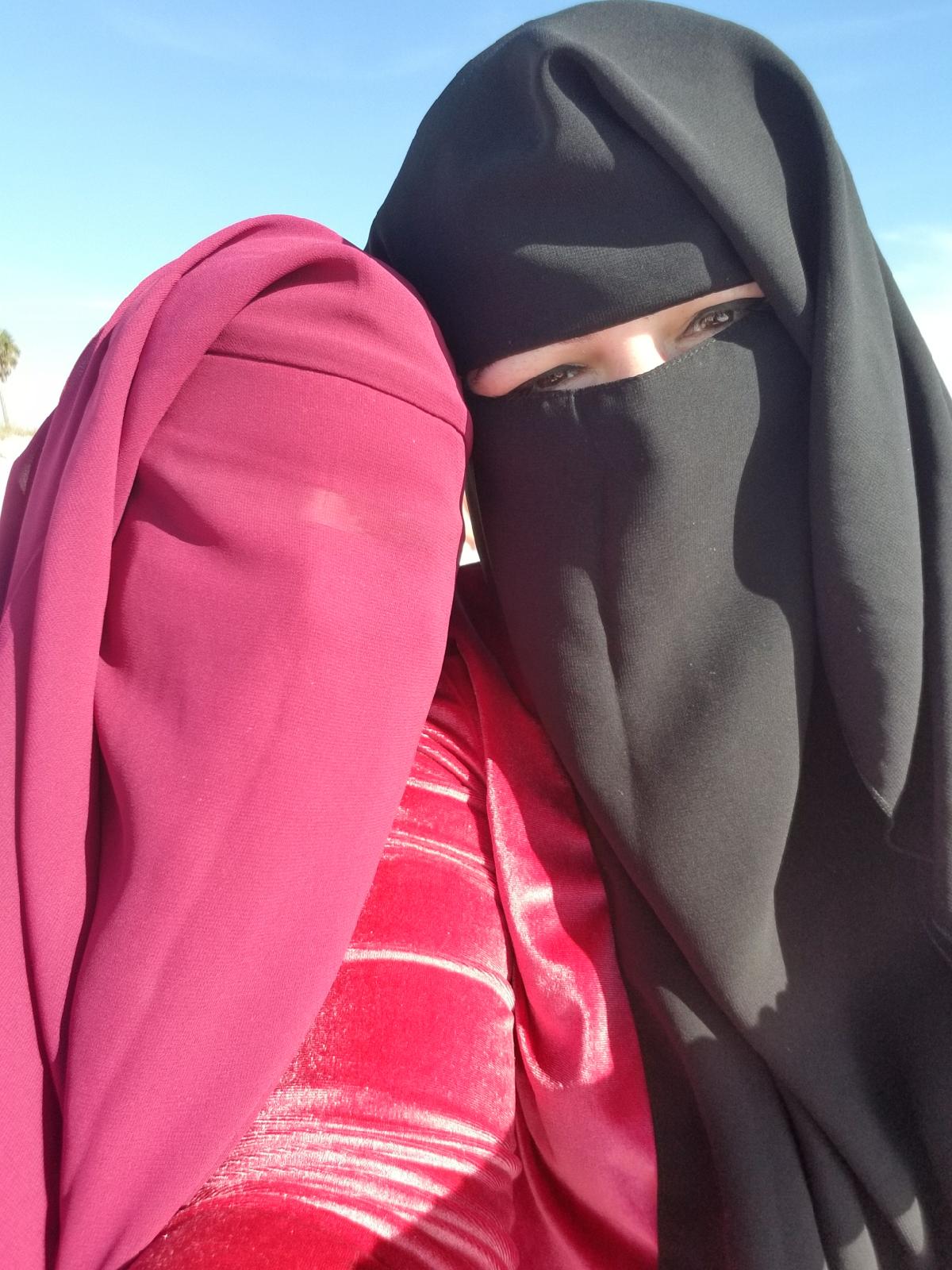
So, the purpose for this video. Obviously initially when I broke my nose it hurt a LOT and so I couldn't do niqab tutorials during that time. after the first couple of weeks I did wear niqab to doctor appointments or to do quick outings, but as I have mobility issues, I never am really out of the house for long periods of time. Due to this, I had no way of knowing that prolonged wearing of niqab is actually painful while my nose is still healing, which we found out when we went on vacation in Florida. We found out because our first day there we went to the beach to meet up with my fellow Jewslim (Muslim Jew!), scholar sister, and when we went for lunch after, it actually got SO painful that we had to switch niqabs! We thought maybe it was just the pink niqab, as it is sewn differently at the bridge than my other niqabs and can cause irritation sans broken nose, but the next day while wearing a different one I was in pain again, and it was decided that I needed to move to part-time niqab while my nose is on the mend. Unfortunately, the ER doctor didn't set my nose, and the ENT appointment wasn't made fast enough, so now we have to wait until my nose finishes healing the break and then I have to have surgery to re-break it and move it back where it belongs! So I may be on part-time status for about a year (please make duaa for me!). It took me a few days to think of wearing boushiya instead!
Alhamdulillah, while boushiya and gashwa, depending on the fabric/niqab/scarf used may not be completely opaque (which I don't have an issue with, but that's a different post), it does cover and obscure the face, at the very least, so I'm glad I was able to think of this, as covering my face is what controls my panic attacks.
So, I'm not sure if you can tell in the video, but the way I did this is for normal length niqabs. With these, the veil layers won't be cumbersome when flipped forward for sitar or when used, as here, as a boushiya. However, the niqab I used is actually an XXL niqab, so I also put together the following picture tutorial on how to use an XXL niqab as boushiya!
First, take your niqab and face it the way you normally would:
Take the face veil and flip it so it is on the outside:
Tie your niqab, then flip back layers like normal:
I like to place the band of the niqab up on my forehead, near my hairline for this look, like in the picture below, especially now as it takes any pressure off of my face so my face/nose won't hurt:
Here was my final look on the way to my doctor's appointment today! Alhamdulillah I got TWO compliments on my "bad hair day" hat! Last appointment (where I had worn ghoongat, a style of South Asian boushiya or gashwa) a fellow veteran had insulted me, which was very disappointing. So I was glad it got returned to me twice today, and the first person gave me salaams after the compliment. 👸
So, here you are, akhiwat! A quick and easy way to use a 2+ layer niqab as boushiya instead. This can be used if you have some nose irritation, such as from a new piercing or a break; I have also used it when the weather was too hot and humid for a niqab to be practical, so using boushiya instead kept my face covered while still allowing me to breathe easily, kept me cooler in the heat, and shielded my eyes from the sun!
If you have any questions or requests, PLEASE let me know! In shaa Allah I will get to them, and I already have tutorials lined up for the next two weeks, alhamdulillah, so I plan on sticking around! 😅
Jazakum Allahu kheiran!
Sajida.
Me and my dear sister Azrah that first fateful day at the beach when we realized even a healing broken nose with niqab for an extended period of time was a no-go. Check her out on YouTube as Ezra Katz!
Hello brothers and sisters! Today's Deen Talk! is on anxiety, masjihid, and cliques. This is something I have heard so many reverts talk about - how they are nervous to go to the masjid, and when they do, it's segregated or people look down on them for being of a different race, ethnicity, way of dress, etc... So in shaa Allah we will address these things in today's talk.
We've discussed in previous Deen Talk!s that anxiety can be heightened when doing new things within a new religion, such as going to the masjid, attending an iftar, or attending a halaqa. But today I want to touch on something people don't necessarily want to talk about, which is that the Ummah is part of the problem.
Absolutely a new Muslim will likely feel anxiety upon going to the masjid or a halaqa or an iftar for the first time - this is only natural. But the issue I'm talking about is that, on top of this natural anxiety, the Ummah has a tendency to make reverts, or even Muslims who have recently moved into a new area, feel unwelcome. I can't completely speak to what happens in the men's musalah, but I have received more greetings and kindness in the masjid from men than I have from sisters, astaghfirullah. If it wasn't for my Khala taking me in and bringing me to sit at her table with her daughters, I don't know that I would have been able to continue attending iftars in my first two weeks as a Muslim. I walked into the womens' food area and stopped in my tracks, unsure of who to talk to or where to sit, and even more nervous because there were few sisters my age and nearly everyone was speaking Hindi, Bangla, etc. Alhamdulillah for my Khala, who came over and took me to sit with her, or I may have just left! Wallahi. She was the only one to come talk to me until a bit later, after prayer.
It was even more noticeable this year during Ramadan. My masjid is building the women's musalah, and the eating area got smaller due to this. Most of the older women sat with their specific group of friends, even going so far as to move my stuff to take the seat I was using when I went to make wudhu. Astaghfirullah. My co-wife didn't know what to do when it happened so she just moved us down further so it wouldn't happen again. Some of the Aunties at the masjid would return my salaams but with a bit of annoyance (due to them being in conversations with their "clique"). Now this isn't to say all of the Aunties were like this. I had several who spoke with me and hugged me and told me how good it was to see me without my cane, etc. But this experience happens frequently enough that it must be mentioned.
Even worse is outside of the masjid. In the mall, in the store, wherever, I tend to give salaams first and 90% of the time my salaams are not returned and I'd say 70% of that I get glares instead. I have wondered if it is because I wear niqab, and perhaps people disapprove of my niqab so they don't give salaams (astaghfirullah...); however, an Auntie who runs a store was talking with me and my co-wife, and she said it happens to her as well every day.
There is a culture of exclusion in the Ummah, one that can and will cause a breakdown of the community if we don't fix it.
We all have rights on each other in Islam, the foremost of them being to send and receive salaams, and to respond to salaams in an equal or greater way. But within our communities, people are so focused on their specific heritage or their specific friend-group that they exclude others. The Prophet, salla Allahu alaihi w salaam, said:
"There is no superiority for an Arab over a non-Arab, nor for a non-Arab over an Arab. Neither is the white superior over the black, nor is the black superior over the white -- except by piety."
Yet still today we see sisters being asked to find another mosque to attend due to being Black. Brothers being turned down as marriage prospects because they aren't Pakistani, or because they are a revert, even though they outmatch others in Imaan and taqwa and knowledge of Deen. Our generation, the younger generation, has fought against this kind of segregation our whole lives - we grew up being taught about Martin Luther King, Jr., about the Civil War, about segregation and how immoral it was. We grew up in school learning, at least explicitly, that we are all equals (even if later down the road we learn that the stumbling blocks of institutionalize racism and other problems still exist and are in need of being torn down). It's because of this many of us are so vocal about inequality and racism and why so many of us are activists in our own right.
Unfortunately, the same can't always be said about the generation before us, as shown above.
This is where we tend to see the "cliquishness" in our Ummah. We see walls put up which exclude new Muslims who want to be a part of the community - invite-only or (astaghfirullah) pay-to-enter iftars, private halaqas, paid Eid gatherings. How are new Muslims supposed to join and engage in a community which shows them they are unwelcome?
For instance, iftars. My masjid does nightly iftars during Ramadan which are completely free and open to the public, no invite or reservation required. And alhamdulillah. Allahumma barik lahum. This is how it should be done! But in a larger masjid in a more affluent area, iftars are invite-only, and you have to know someone who knows someone in order to get in, should you be new. I was invited and able to attend one such iftar since I have an Auntie I befriended who knew the people organizing it. But while I was there, the only people I spoke to were that Auntie and the host. No one else introduced themselves, no one really spoke to me or my co-wife until the Auntie we knew introduced us to people and showed them some of my work (I make products to help reverts learn salah). Even then, it really was only the one Auntie who paid us any mind.
It's going to fall to our generation of Muslims to fix these things within the Ummah. We are going to have to insist upon equality between races and ethnicities and born vs. revert Muslims. We are going to have to insist upon always giving salaams, even if people continue not to reply (you will get the reward - they are only hurting themselves). We are going to have to go to our Imams, our Boards for our Masjihid, our outreach groups and request things which allow women to more easily attend the masjid, which help reverts and new Muslims to the area navigate the mosque, "Big Brother Big Sister" type programs to help new Muslims learn the basics (like it was during the time of our Prophet, salla Allahu alaihi w salaam).
And it is going to be hard. And we are going to feel lonely. Those who insist upon cliquish behavior likely will not wish to change. But we need to band together, even if we don't live near each other, and stay strong in this Jihad to make the Ummah more open and friendly and an actual COMMUNITY, as it is supposed to be.
This is the first installment in a four-part series on revert problems. Today we talk about the first thing new Muslims really have to deal with - how to tell their friends and family that they are, or soon will be, Muslim.
In a society in which Muslims are regarded as terrorists, what is a new Muslim, or prospective Muslim, supposed to do when it comes to telling people that they have accepted Deen al-Haqq? If they live in an environment where people are extremely Islamophobic, is it permissible to lie or at the very least hide one's religion? Should new Muslimahs refrain from putting on the veil? How does one pray in a home where relatives refuse to accept their loved-one's new faith and who may even become violent at the revert's attempts to pray?
There are several responses to the above questions, all varying based upon what path or scholar a person follows. When it comes to lying about being Muslim, there is a concept in Shia Islam called taqiyya. This concept draws from Surah an-Nahl, ayyah 106:
With the exception of those who are forced to say they do not believe, although their hearts remain firm in faith, those who reject God after believing in Him and open their hearts to disbelief will have the wrath of God upon them and a grievous punishment awaiting them.
This is understood to mean, according to those who practice Shia Islam, that one in danger may deny belief in Islam verbally while still believing in Islam within one's heart. Regarding taqiyya, the major Sunni belief is that we should not verbally deny our faith as this is cowardly. Rather, we should die as martyrs, with the Shahada on our lips; however, eating pork or drinking wine under duress or threat of death is allowed and encouraged over acceptance of death by hunger or thirst.
Some scholars, both Shia and Sunni, have issued fatawa permitting Muslimahs in the West to take off the veil if they feel unsafe wearing it where they live. After the claim that khimar is not fard, this is the most liberal opinion. For many, however, wearing of the veil can be likened to verbally accepting Islam, so to take it off could fall under the label of cowardice previously mentioned. For many Muslimahs, the middle road is to cover in more socially acceptable styles. Unfortunately, many get harassed then for not wearing hijab "correctly" (please see 'Women in Islam - Part 2 - Hijab and Supporting our Sisters' for more information).
Styles which cover less and/or show hair are generally viewed as "less extreme" by many non-Muslims.
When new sisters wear the tichel (Jewish style), shayla (loose style), or turban style coverings, whether out of fear of safety or due to being new to hijab, these sisters are then often harassed by those within the Ummah, which only further compounds the issue, making new Muslims, who likely feel alienated from their friends and family (who may have stopped speaking to them after they found out their loved one became Muslim) now are also being alienated by the family they chose - the family of the believers.
Some sisters are in situations where they cannot wear khimar or even modest clothing due to living with violently islamophobic individuals. I've had several approach me to ask what they should do and how they can pray without being attacked, verbally and physically, by the people they live with (usually out of necessity). For example, one sister has been in a situation so severe that if she closes her door for even a moment, her father will angrily open the door in case he finds her praying. My response to her was that she could pray her prayers at night in bed, so her parents would think she is sleeping. She could pray all of them in succession and can pray fajr from bed on time, in shaa Allah. Before doing the video for this blog, I found a few fatawa saying that since we live in a clean environment and the bathrooms during the time of the Prophet, salla Allahu alaihi w salaam, were absolutely disgusting and only used for waste (in contrast with the restrooms of today which have bath/shower, sink, mirror, make up, brush teeth, put on hijab, etc.), it is permissible for one to pray in a bathroom like this, so long as the toilet seat was put down before flushing and a towel placed on top of the lid to keep germs from spreading, in shaa Allah. I also found that if one does not have proper clothing in which to pray, one should pray anyway. Allahu alam. In all of these it is mentioned that we should have tawakkul (faith in the plan of God) and know that Allah is ar-Rahman ir-Raheem and believe He will accept our salah in these conditions.
Reverts face so many unique difficulties over those of the Ummah who grew up within Muslim household. What is important to remember is that Allah 'azza w jal has made it clear that those who struggle in His cause receive double reward:
Verily the one who recites the Qur’an beautifully, smoothly, and precisely, he will be in the company of the noble and obedient angels. And as for the one who recites with difficulty, stammering or stumbling through its verses, then he will have TWICE that reward.” [Al-Bukhari and Muslim]
We must remain strong, because in today's society, being Muslim and following even the most basic tenets of Islam is Jihad! In shaa Allah, through the rest of this series we will address other problems reverts face, and through this we will reach the whole Ummah and make it more supportive of all Muslims.
This post marks the end of this three-part section on Women and Islam. Today's topic is Feminism - what it is/isn't, what it looks like, and how Islam is inherently feminist.
Feminism is NOT a movement asserting women are "better" than men; this is a misconception due to second and third wave feminism, which focused on white, middle class women (particularly lesbian women in third wave feminism) and which housed a lot of anger toward men due to the great expanse of the inequalities between men and women at the time. The hatred of men is called misogyny and is absolutely NOT synonymous with feminism!
The current stage we are in (and the stage which every Muslimah scholar I know are a part of) is Fourth Wave feminism. While third wave feminism asserted feminism through sexual freedom (re: promiscuity) and women being an equal or dominant partner in a relationship, fourth wave feminism acknowledges that part of equality of and for women is her right to CHOSE. Previously it was said (and is still said among older feminists not part of the fourth wave movement) that one cannot dress modestly and be a femininist; one cannot be religious and be a feminist; one cannot wear hijab or niqab and be a feminist; one cannot be a "traditional" wife (submissive/obeisant) and be a feminist. Fourth wave feminism, however, says a woman is equal when she can make these decisions for herself. So women can choose to wear or not wear hijab, and we can't tell other women how to dress. Women can be submissive to their partners out of choice, and we can't bar her from the label of feminism.
What is wonderful about Islam, from a feminist perspective, is that it afforded women so many rights we previously did not have in Jahaliyyah society. Before Islam, women were possessions; chattel. If she worked, the money went to her husband. If she wasn't married, she essentially belonged to her father (or brother if father was deceased), and upon being married she was a possession of her husband. Women could not inherit unless there were no male to inherit, and once she married the inheritance went to her husband or another male relative. Women did not have the ability or right to divorce; only the male was able to initiate and finish the divorce, so many would trap women in an in-between state where the divorce was not final and they could not remarry, but where the husband had no obligations to her.
In Islam, this is very very different. Take a look at Surah an-Nisa. This surah sets out rules for the inheritance of women, giving her up to half of what the males in the family receive. Now, many people use this to say Islam isn't feminist. However, we need to look at the Quran in the narrative of the holy books in Abrahamic religions and in the narrative of society as a whole. In this we see that before Islam, women could not inherit. After Islam, women were entitled to inheritance! Yes it was less than the men, but Allah ta'ala eases us into things - just as it took 13 years for alcohol to be completely banned within the Ummah, now today societal laws have changed and women receive equal inheritance. Subhan'Allah! Allah al-Alim gives us the extreme on laws in order to guide us to do better.
In Islam, women are allowed to chose whether or not they work. In a marriage, the man is supposed to be able to fully support his wife/wives and children. However, should his wife/wives chose to work, only they are entitled to the money earned unless they decide to share it with the family. We see this in the example of Khadijah, radhi'Allahu 'anha, who was a business owner. Similarly, upon getting married women receive a mahr. Before Islam, men paid a "bride price" to the Wali (male relative involved in the marriage), essentially buying the wife. After Islam, men are instructed to pay the wife the bride price! This belongs only to her, and she can do whatever she wants with it. Should she save it, in the event of divorce the husband cannot take it back and she can use this money (if it was money or other currency given) in order to secure herself until she marries again, if she remarries.
"But what about hijab and niqab? It's so oppressive/backwards/shameful/anti-sex positive!"
Hijab was commanded to protect the women from being harassed. THIS IS NOT SAYING A WOMAN IS "ASKING FOR IT" IF SHE DOES NOT WEAR FULL HIJAB! But we need to look at the historical context of hijab. In Mecca and Medina, women wore khimur (veils) on their heads, but allowed them to flow behind their backs (please see Women in Islam part 3 for more information). There were prostitutes in the area who wore khimur in this way, and the Muslim women were being harassed by men looking to pay for sex! In order to show that they were NOT prostitutes, Allah ta'ala advised them to change how they wore the khimar and also to wear the jilbab. Some scholars also suggest that Muslim women then advised prostitutes and slaves to wear the khimar the Islamic way in order to avoid constant harassment from customers/men in general.
Finally, there is a Hadith from the Prophet, salla Allahu alaihi w salaam, that I wish to talk about (pictured above). Islam preaches for equality in relationships. While, yes, women are called to be obeisant to their husbands, they have rights on their husbands just as their husbands have rights upon them. Women are entitled to fair treatment of themselves and between wives. They are entitled to love and respect. They are entitled to sexual pleasure (and female genital mutilation of children and grown women is banned as it is harmful and also removes the ability for women to have sexual pleasure). Rasulullah, it is narrated, salla Allahu alaihi w salaam, would help his wives clean and cook. He would joke with them and laugh. He was, subhan'Allah w bihawmdihi, a full and equal partner in all of his marriages. Allahumma barak 'ala Muhammad w 'ala ali Muhammad.
We need to remember that in the Quran, Allah 'azza w jal first called upon men to observe hijab and THEN called upon the women. He provided women with a minimum for rights they never had received before, calling on us to go above and beyond in fairness and mercy, and He provided women with a way to show that they were not prostitutes while out and about in the city and the market (from which we can deduce that women are not required to stay within the home but can, in fact, work or go to the market to shop, etc.). Because Allah ta'ala and His Messanger, salla Allahu alaihi w salaam, called upon us to give women these never-before-heard-of rights and provided us with the perfect example on how to treat women, Islam is easily seen as inherently feminist. Now it's up to us to continue the progress started centuries ago in order to give women full societal equality so we can live up to the example of our Prophet, in shaa Allah.
Jazakum Allahu kheiran! Please let me know if there is anything you would like me to cover in the future.
Today's topic is quite long, so you've been warned! (And I'm sorry this is late - family emergencies.) The topic we are covering is Hijab and Supporting our Sisters.
First off, let's answer the question of what is hijab?
Nowadays people argue that hijab (as in the headscarf) is not required in Islam, and that the Quran never mentions hijab. This is a huge misunderstanding of the text. Hijab itself means veil, covering, or screen; it refers to ones dress, actions, and thoughts, and is a synonym of hayyah, or modesty. Allah ta'ala commands hijab in Surah an-Nur, ayyah 31:
And tell believing women that they should lower their glances, guard their private parts, and not display their charms beyond what [it is acceptable] to reveal; they should let their headscarves fall to cover their necklines and not reveal their charms except to their husbands, their fathers, their husbands’ fathers, their sons, their husbands’ sons, their brothers, their brothers’ sons, their sisters’ sons, their womenfolk, their slaves, such men as attend them who have no sexual desire, or children who are not yet aware of women’s nakedness; they should not stamp their feet so as to draw attention to any hidden charms. Believers, all of you, turn to God so that you may prosper.
Here, where M.A.S. Abdul Haleem uses the word "headscarfs," he is translating the word "khimur," which in pre-Islamic times referred to a headscarf or veil worn by women, Pagan, Jewish, Christian, or otherwise. Women at the time, especially prostitutes, would wear their khimur behind their backs in order to be enticing or seductive. So this ayyah is a command to take what is already present, the head covering, and change how it was worn in order to mark the women who did so as Muslim.
Here are a couple examples of how the khimar might have been worn in jahiliyyah society. Notice how the khimur fall behind the backs of the women, leaving the chest uncovered and even exposed.
Another command for hijab comes in Surah al-Ahzab, ayyah 59:
Prophet, tell your wives, your daughters, and women believers to make their outer garments hang low over them so as to be recognized and not insulted: God is most forgiving, most merciful.
Here, Haleem chose to translate "adna al-jilbab" as making garments hang low, rather than as wrapping around, as others had translated. From this we can interpret either that women should wear long clothing/dresses or khimur, or we can understand it to mean that women should have a separate outer garment over the clothing, which should cover the woman and hang low, either from the shoulders or the head (such as what is now called abaya or jilbab). Again, we see that the reasoning behind the command is to keep the women from being harassed or insulted by being propositioned as prostitutes.
The Quran, also in Surah al-Ahzab, commands special hijab for the wives of the Prophet, radhiAllahu 'anhum, saying that they should speak from behind a screen for even further modesty due to their connection with Rasulullah, salla Allahu alaihi w salaam.
So, we can see that it is clear in the Quran that women should dress modestly and wear a headscarf in a particular manner. The question then is what all is to be covered. Allah subhana w ta'ala specifies in the Quran how to wear the khimar, that it should be brought forward to cover the chest and some translate to also say neckline or even chin. It is clear from the second ayyah that clothing should hang low to cover the body and, possibly, that women should have special outer garments for outside the home. But we don't have any specifics from within the Quran as to what, exactly, should be covered by clothing or jilbab. For these, we turn to the Ahadith. One main Hadith that comes to mind, though it's not classed as Sahih, is the following:
Asma’ bint Abi Bakr entered upon the Messenger of Allaah (peace and blessings of Allaah be upon him) wearing a thin dress. The Messenger of Allaah (peace and blessings of Allaah be upon him) turned away from her and said, “O Asma’, when a woman reaches the age of puberty, nothing should be seen of her except this and this”
It is narrated that the Prophet, salla Allahu alaihi w salaam, pointed to the hands and the face, going back to the original ayyah and marking "what is readily apparent" for a woman to be able to do business, pray, etc. (as face and hands should be uncovered while performing salah). However, when we look at how women in Muslim countries dressed pre-contact (and contamination) by the Western World, we can get a better idea of how early Muslims interpreted hijab, jilbab, and even niqab from both the Quran and the Sunnah. Here are some examples:
Egypt
Egypt
Egypt
Egypt
Algeria
Saudi Arabia
Palestine
Eritrea
Here we see different understandings of the command of hijab (please note the color photos are modern pictures of women in traditional dress; others are photos from the late 19th century when social anthropology work started up). All wear clothing which goes low to the ground and is loose. All cover the hair with khimur, and while some wear a specific jilbab or outer garment, others appear to just be wearing their normal, loose clothing accompanied with a long khimar (rather than wearing yet another garment over their normal clothing). We can see that in most of these photos, the forearm is visible due to sleeves being loose instead of form fitting, which is easier to make by hand and cooler in the heat of the desert. We can see that sometimes some hair can be seen, or a collarbone shows when the jilbab loosens while carrying something, and that niqabs did not always completely hide the face and clothing was decorated.
Because of this, and because of the grey area in the Quran and the weakness of the hadith which shows specifically what may or may not be shown, we tend to have conflicting understandings as to what is and is not hijab, what is and is not "adornment," and what is and is not tabarruj. Which brings us to the actual topic:
Supporting our Sisters!
Too often we see new sisters harassed for not "correctly" following hijab. What we need to remember is that right now, we face so much more resistance to dressing in an Islamic manner. In Western society, a t-shirt with jeans or a midi/maxi skirt is seen as modest. When sisters, both reverts and born Muslims, start to try to wear hijab, they first put on the headscarf, as that is what society teaches is "hijab". But we shouldn't be rude to these sisters, saying to them "Jahanam is hotter" for wearing their scarf in a turban style in the heat, or wearing hijab with a short-sleeved/three-quarter-sleeved shirt (as I have seen many South Asian sisters and some new reverts do), or wearing belts at the waist or not wearing abaya. Unfortunately, though, this is what many face, especially on Instagram. Then, even as a sister evolves in her modesty, she gets harassed for even posting pictures of herself online. We need to remember that modesty is a PROCESS, especially in today's society! If we don't grow up with our moms and our friends' moms' and so on and so forth wearing khimar and abaya or jilbab, how can it be easy for us to do so? If we grow up seeing women on television in short skirts and crop tops, what else do we know of fashion? And if we live our lives wearing shorts and tank tops but then become Muslim and want to abide by hijab, which is obligatory, how much more difficult is that change?
We need to remember that how we show our devotion to Allah 'azza w jal is between us and Him. Instead of harassing or attacking our sisters, we should focus on their efforts and commend them for starting the Jihad which is hijab (because, yes, it absolutely is a Jihad in today's society)! We should say, "Sister, I'm so proud of you for trying to start to wear hijab! Here is how I understand it, and here is why." We should realize most people cannot make an instantaneous switch from shorts to jilbab. Encourage sisters to continue learning about hijab and what it is and what it means. Invite her to try abaya or jilbab with you one day, so she doesn't feel so anxious in a society that views Muslim women not in Western clothing as terrorists. Answer her questions. And make duaa for her. But don't shame her for not yet meeting what you understand to be the standards of Islamic modesty, since the bar for this changes depending on the madhab and aqeedah a person follows. Do you want to be part of the reason someone chooses not to become Muslim, or even - astaghfirullah - decides to leave the Deen all together? The kinder we are, the more our sisters will listen, in shaa Allah.
Jazakum Allahu kheiran for sticking with me through the long video and text-heavy post!