Assalaamu alaikum! This blog post is on Ramadan and what we can do if we are unable and exempt from fasting. This is a really tough subject for a lot of Muslims, especially ones who suffer from mental illness. Because there is so much stigma in our communities, people feel that their mental health should be sacrificed in order to fast, when, in reality, they are exempt from fasting due to having medication which cannot be moved to night time or because of the illness itself.
Those who are exempt:
Those who have medicine to take throughout the day which cannot be moved to dark or pre-dawn hours.
Those who are ill or will become legitimately ill by fasting (this would include those who would relapse from eating disorders as well as those who have hypoglycemia or suffer hypoglycemic attacks when fasting - please consult your doctor).
Those who are on their period.
Those who are pregnant.
To quote my lovely scholar-friend (whom I've been referencing oh so much!), Tuscany:
"...if you are exempt, take it as a mercy on you that He has made fasting haram for you. Fasting is a hollistic thing so everything like no food, no water, no sex, etc. is all under the same umbrella and there is no partial fasting. In the event you [can't] fast for medical reasons, it is required you feed the poor or free a slave but in this day and age, people just feed the poor."
So, if we can't fast, what can we do?
Focus on bettering your relationship with your Rabb! Read the entire Quran, in Arabic or the language of your choice. Practice reading the Quran in Arabic (every letter read gives one reward when it's NOT Ramadan, so imagine the reward DURING Ramadan!). Learn 3-4 of the 99 names of Allah ta'ala every day and embrace the attributes within yourself. Read about or watch/listen to the Seerah of our beloved Prophet, salla Allahu alaihi w salaam, and empower yourself to emulate his best characteristics. Feed the poor, help the needy, make lots of duaa for those around you. Give Dawah to those whom you love; every night in Ramadan, Allah subhana w ta'ala chooses people to be saved from the Hell Fire.
Jazakum Allahu khairan w Ramadan Mubarak w Kareem!
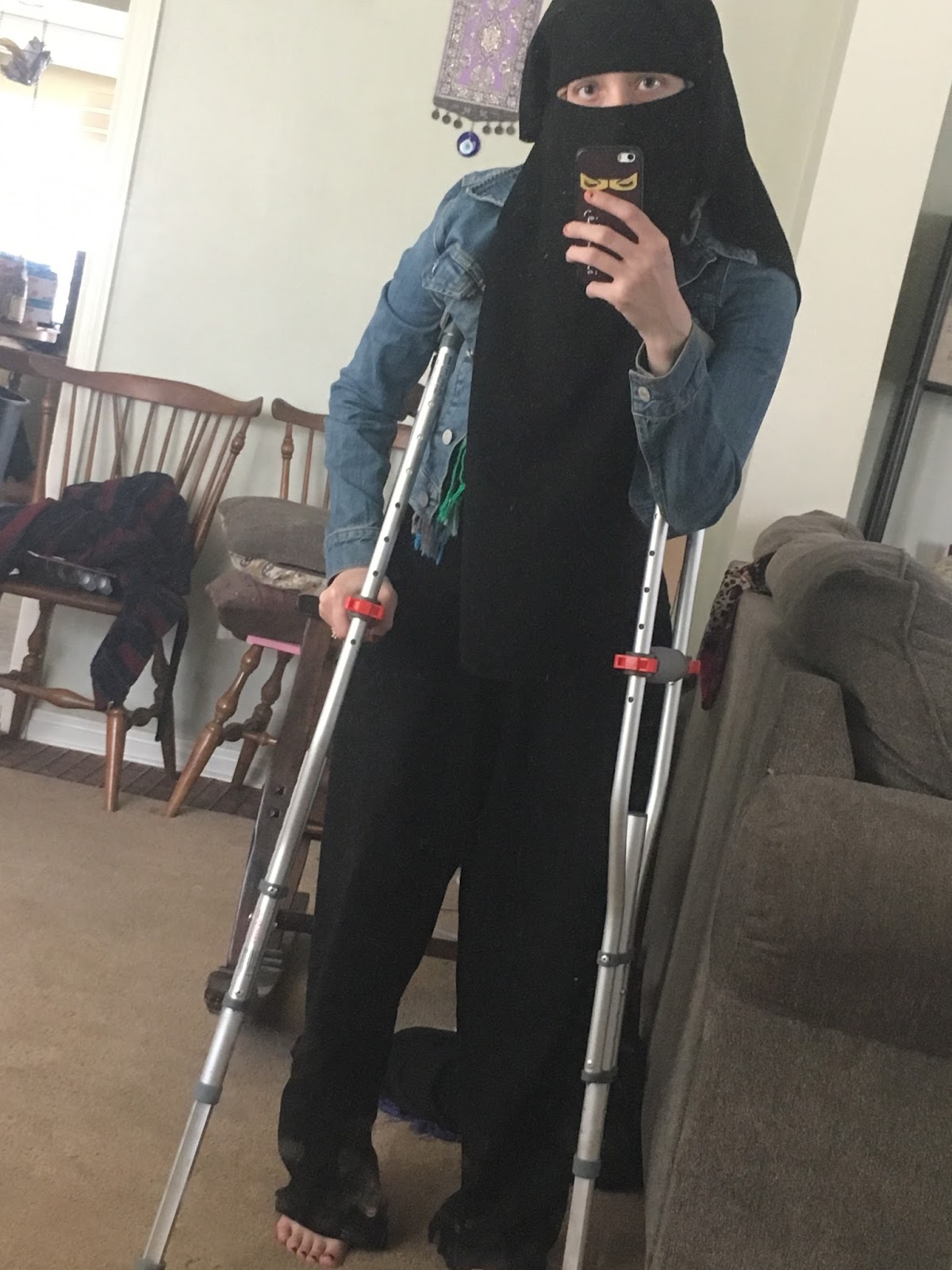
Assalaamu alaikum everyone! This blog focuses on Islam and physical disability, including invisible illnesses such as fibromyalgia, rheumatoid arthritis, or lupus. This is a really important topic to me, as a young adult who is physically disabled. I don't really take pictures showing my cane (or currently, crutches), but I do struggle every day with my mobility, and this has affected my prayer.
Probably the largest issue Muslims with disability face in our daily life is the issue of Salat. How does one pray when they can't stand, or bend over, or even make wudhu? This was my biggest concern upon reverting to Islam. At first I was able to pray standing, but my physical health continued to get worse which made it quite difficult. Alhamdulillah I had previously found information on how to pray sitting. And when it became even more difficult, where there were days I could not even get out of bed, my Imam and other friends and scholars were there to help me and answer my questions.
Ibn Qudaamah (may Allaah have mercy on him) said: If standing will make a sick person’s sickness worse, then he should pray sitting. The scholars are unanimously agreed that a person who cannot stand may pray sitting. The Prophet (peace and blessings of Allaah be upon him) said to ‘Imraan ibn Husayn: “Pray standing; if you cannot, then sitting; and if you cannot, then lying on your side.”
It was also narrated by al-Bukhaari, Abu Dawood and al-Nasaa’i, who added: “If you cannot, then lying on your back, and Allaah does not burden any soul beyond its scope.”
It is also narrated that if one feels that standing would increase sickness, delay recovery, or it will be too difficult for him to stand, then he can pray sitting down.
If one is unable to stand to make wudhu (or even for able-bodied persons finding themselves in a place without water to make wudhu for prayer), then it is permissible for him to make tayamum. Tayamum is taking something from the earth (rock, sand, dirt, even wood) and using it to attain a state of ritual purity before prayer. Some scholars say you can use anything from the earth, while others say it must leave a sort of residue on the hands prior to you shaking or brushing them off.
I keep a stone humidifier near me in order to make tayamum, either in the mornings if I cannot stand to walk to make wudhu, or during the day now since I am on crutches and walking to the bathroom or kitchen is difficult and I can't bend or lift my leg (or stand on my right leg) in order to complete wudhu. Some keep a small box or plate with sand or dirt inside. If I find myself without my stone to make tayamum, I have used wood or the wall (since it's made of plaster which is a sort of dirt or rock powder), but I prefer to use the stone as I can feel a slight residue when using it.
Another concern I had upon becoming Muslim was that my cane or other walking aid might be considered as having najis (impurity) and therefore not allowed inside the musalah. Alhamdulillah, I was informed this was not the case, even if we must remove shoes to enter the musalah for prayer. Canes, walkers, crutches, and wheel chairs are all allowed within the musalah, from what I have been informed and seen within the mosques near me. However, I have seen that those who are disabled and require a support dog have been asked to leave their dog outside (not at any of my masjids but I have seen this response on certain Islamic websites which I have seen and been warned have some questionable responses). If you have a support dog, I would speak with your Imam and explain that this is a working dog, it is not going to go to the bathroom inside or bark or otherwise distract people during prayer. Dogs are NOT haraam (that will be another post), but many madhabs do consider dog saliva is najis. I would explain that a) this dog is a medical necessity for you, be it to warn you about an oncoming seizure, as a walking aid, seeing-eye dog, reminder for medicines, PTSD, etc. b) the dog cannot be kept outside ethically and should not be, as extreme weather is dangerous for the dog and it also exposes the dog to dangers such being taken by someone as the dog is not being watched and protected, nor is it inside a fenced area.
In shaa Allah this has helped people to understand and broach the subject of disability in Islam. Please if you have any questions or you want to see a specific subject discussed, let me know!
Assalaamu alaikum everyone! This finishes up the Mental Health segment of Deen Talk!, in shaa Allah. Please note I am not a student of Ruqya. However, I will list my sources during the course of this blog.
So, let's start with the basics. What is Ruqya? Ruqya is Islamic Healing, which we get from the Quran and Sunnah. There are three rules when it comes to Ruqya:
1. It should words, names, or attributes of Allah subhana w ta'ala.
2. Words must be in Arabic -OR- have otherwise intelligible meaning (English, Spanish, any living language), to avoid witchcraft.
3. It must be believed and acknowledged by the practitioner that the benefits of Ruqya com directly from Allah ta'ala, and not from the practitioner themselves.
One can ask for Ruqya to be performed upon them, or they can do it upon themselves. Basic Ruqya can be performed at home for general aches and pains. There are two very basic Ruqyas, garnered from some Ahadith, which anyone should be able to perform.
The first is to recite Bismillahi three times with hand upon the painful spot:
The Prophet, sallallahu alayhe wasallam, told Amr ibnul Aas, "Place your hand where you feel pain and say 'Bismillah' three times, and then repeat seven times A'oudho bi'izzatil-lahi wa qudratihi min sharri ma ajidu wa 'uhadhir. (I seek refuge with Allah and with His Power from the evil that afflicts me and that which I apprehend.)" (Muslim)
The second is to blow upon the person and recite Surah Fatiha:
A group of the Companions of the Prophet (peace and blessings be upon him) set out on a journey and traveled until they came near one of the Arab tribes. They asked them for hospitality but they were refused. Then the leader of that tribe was stung, and his people tried everything to cure him but nothing helped. Then some of them said, "Why don’t you go to those people who are staying (nearby)? Maybe one of them has something." So they went to them and said, "O people, our leader has been stung and we have tried everything and nothing helped him. Do you have anything?" One of them said, "Yes, by Allah. I will perform Ruqyah for him, but by Allah we asked you for hospitality and you did not give us anything, so we will not perform Ruqyah for you unless you give us something in return." So they agreed on a flock of sheep, then he started to blow on him and recite Al-hamdu Lillahi Rabb il-`Alameen. Then he recovered quickly from his complaint and started walking, and he was completely cured. After that they took the flock of sheep, and some of the companions of the Prophet (peace and blessings be upon him) said, "Let us share it out." The one who had performed Ruqyah said, "Do not do anything until we come to the Prophet (peace and blessings be upon him) and tell him what happened, and we will wait and see what he tells us to do." So they came to the Messenger of Allah (peace and blessings be upon him) and told him what had happened. He said, "How did you know that it is a Ruqyah?" Then he said, "You did the right thing. Share them out, and give me a share." And the Messenger of Allah (peace and blessings be upon him) smiled. (Al-Bukharee and Muslim)
According to Bukhari, one can also recite al-Mu`awidhatayn (Surat Falaq and an-Nas) and spit dryly to heal illness.
The benefit of the above Ruqya for the average Muslim is quite obvious. However, most of Ruqya isn't about general aches and pains or minor illness but, instead, focuses on afflictions caused by Jinn Possession, Witchcraft, Ayn (the Evil Eye), devils, etc. This is where the stigma against mental illness is seen the most.
There is a Hadith which recounts that we should request Ruqya to be performed upon us:
With regard to the hadith narrated by Muslim, according to which the Prophet (peace and blessings be upon him) described the seventy thousand of this Ummah who will enter Paradise without being brought to account or punished, and in which it says: "They are those who did not recite Ruqyah or ask for Ruqyah to be done, and they did not believe in bad omens and they put their trust in their Lord " – the phrase "they did not recite Ruqyah " is the words of the narrator, not of the Prophet (peace and blessings be upon him). The same Hadith from Bukhari thus does not contain the phrase.
So we are supposed to request Ruqya services. However, as seen in the above Ahadith, Ruqya should be requested AFTER conventional medicine has failed. We see this in the Hadith about the Ruqya about Surah Fatiha, where the man was brought to the Sahaba, radhum Allahu 'anhum, after normal medication failed. The Ruqya Services lists in the symptoms section of its website that help for Jinn Possession, Witchcraft, and Ayn can only be diagnosed after the patient was unable to be diagnosed by a doctor or after all treatment has failed. Unfortunately, in many Muslim countries, the society is considered underdeveloped. In these countries, those with mental illness are often brushed off as having anxiety or depression caused by Shaitan, with any more serious disorders blamed on Jinn Possession, Witchcraft, or the Evil Eye. They are denied medication and adequate treatment in the name of Islam. Astaghfirullah. These poor brothers and sisters are shamed for needing medication or therapy (which cannot be provided) whenever Ruqya treatment fails, or accused of witchcraft themselves.
This is at the crux of why I decided to do these videos and blogs, to bring up that mental illness should not be taboo in Islam. While, yes, Jinn Possession, Witchcraft, Ayn, and devils can cause many afflictions, we should not brush off mental illnesses, many of which are chemically based as proven by science. Instead, we should allow and support our brothers and sisters when it comes to seeking psychological treatment. Then, if this fails (please keep in mind people may need to try several medications or therapies before reaching stability), we should allow and support them in seeking treatment via Ruqya.
For more information on Ruqya, please visit the following sources (note: The Ruqya Services appears to discredit Sufism as a branch of Islam):
Today's video is on glasses and niqab. Unfortunately, I don't have too much expertise in this area, so I consulted my friend Tuscany, pictured above! Tuscany was kind enough to give me some intel on the BEST companies to buy niqabs from - in her experience - if one wears glasses. Unfortunately, her favorite company is no longer in business, but we have two very good companies for sisters out there who need to wear glasses or sunglasses frequently (the sister who requested this had her doctor say no using eye veils, she MUST use sunglasses outside, hence this "tutorial"!).
Here is the video, and then we will will get into the nitty gritty!
So some basics:
As you can see, Tuscany places her glasses on the inside of the niqab. This is why she recommends these particular brands, as they are good for everyday glasses wear.
If you are only wearing glasses for certain activities, you may prefer to place the glasses on the OUTSIDE of the niqab (but comfortably between layers if a layered niqab), as I do. This allows you to slide them up on top of your head.
For fogging, Tuscany says to try tying your niqab differently until you find a position that puts the eye holes in a position that keeps you generally fog-free. As in the video, this may not work with self-wrapped niqabs depending on the style.
Sunnah Style narrow "no pinch" single layer niqab
The first company I want to talk about is Sunnah Style. You may remember I did a side-by-side of a Sunnah Style niqab and my niqab from Misk of Jannah on another post. Sunnah Style makes special "no pinch" niqabs for people with glasses. The full version creates a kind of box instead of a closed point where the headband and niqab meet. Tuscany prefers the narrow version, above, which has a small boxed angle on the bottom half of the point. These niqabs come in 1, 2, and 3 layer as well in many colors. They can be purchased here.
Niqab Co. 3 layer, medium
The second company is Niqab Co. Niqab Co. is well known for their innovative "belt buckle" style closure niqabs. What you may not know is that they offer different eye hole sizes on their niqabs! Tuscany goes with a medium for her glasses, but depending on the person you may require a large. Niqabs can be purchased here.
Mi Modesty's founder, I'esha Abdullah, in her Niqabi Queen style niqab.
Finally, Tuscany wanted to give attention to a small business she loves, Mi Modesty! Mi Modesty's specialty is the "Niqabi Queen" style niqab, which has a crown or tiara design on the headband of the niqab! Tuscany loves her Niqabi Queen niqab (pictured in the intro pic) and says that the eye holes are perfect for her glasses. You can see the wide eye hole shape similar to the narrow "no pinch" shape from Sunnah Style. Mi Modesty also makes niqabs with "ski-mask" style openings for those who need an even less pointed area for glasses! Check out this small business on their website, here.
In shaa Allah this has answered all of your questions on niqab and glasses! If you have questions or want to see something in particular, please comment!
Assalaamu alaikum, ladies! We've all seen the cheapo, $3 niqab gloves pictured above, sold on various sites in a myriad of colors. And I bet we've all had the struggle of wearing gloves and having to take the gloves off to use our phones, whether it be for texting, to make a call, or to read Quran. It's a HASSLE. But as shown in my texting-glove review, gloves that are made smart-phone capable can be EXPENSIVE, and not all of us have the ability to just run out and buy a $30 pair of gloves (especially if you have a tendency to lose only one in a pair, like me...).
Due to this, I figured out a way to alter the gloves in order to allow for smart-phone usage. No, this doesn't involve some magic metal glue or metalic yarn... It's super easy, and you only have to do it once! What did I do? I created slits!
What you are probably expecting...
No, they aren't ugly and easy to spot. Don't worry! These slits are so sneaky, you can't even tell they are there!
Finished product.
So, how do we get these super awesome sneaky slits? Well, unfortunately you have to start out by making the ugly slits in the first photo. THEN, turn the glove inside out so you can see the inside portion of the thumb.
We are going to create two stitches on each side of the slit, with the part of the glove which is going OVER my thumb in the photo being on top of the stitch, so it overlaps (my thumb is the same direction as the thumb of the glove).
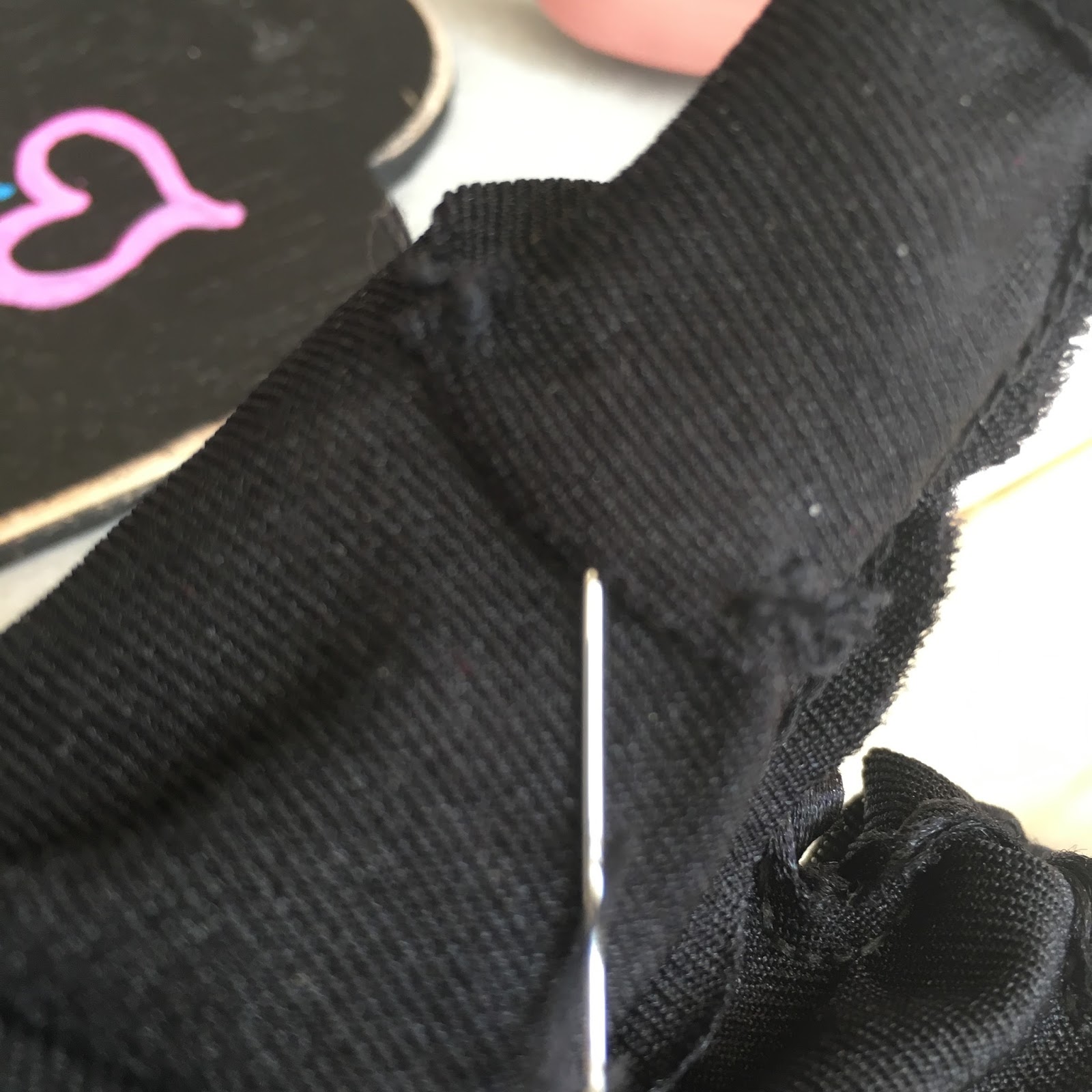
This is the thumb inside out, with two stitches, one on each side. I made each stitch a triple stitch to keep it from coming out or pulling easily.
Now, flip the glove right-side out, and test your thumb-slit!
If the slit feels too big or is easily noticable, just turn everything inside out again and put in a third stitch.
Aaaaand, you're done! From the front and back of the glove, it's virtually unnoticeable, and now you no longer have to take off your gloves and compromise your modesty and/or mental health in order to use your phone.
Assalaamu alaikum, ladies! Today's tutorial is how to create your own UAE-Style Gashwa, as shown above! Also known as a ghatwa or boushiya, it's a square or rectangle of fabric consisting of several layers, one of which is flipped down to cover and conceal the face. Women wear these both with and without separate niqab. The one in the picture above is an actual UAE gashwa. The one we are creating today includes pins, but they can be removed if preferred.
First step in creating your gashwa is picking a scarf or fabric. The ones you can get in the UAE are made of a thin cotton or gauze-like fabric, which, as you can see, is very sheer. This has the added benefit of increased breath-ability, heat control, and sight. If you plan to make a permanent one, I would suggest trying several fabrics to find one you can see out of well. The scarf I used is a georgette fabric wide rectangle scarf from Al-Mujalbaba, which can be purchased here. This fabric gives an increased opacity as opposed to the cotton gauze used traditionally. However, it can be a little harder to see out of as well as warmer in the sun.
You'll want a rectangular piece:
From here, we will fold it in half, creating more of a square:
You then fold it in the same direction one more time. I prefer a layered look, but you can also fold it so it is completely even.
You can be finished here. I, however, added pins in order to give increased stability of the gashwa due to my using a cane. If you want to add pins, you can proceed as below, adding as many or few as you wish:
Where the pins are is also where one would stitch across, if desired, but on the inside, at the point where you would wish to fold your gashwa (so you would be stitching across TWO layers, not the four as here). You could then also cut so the bottom, folded "layer" so it becomes two separate layers.
Next, if you pinned it, flip it so the pins are on the inside of the four layers. You'll see a sort of crease:
Then, place it on your head and flip down the upper-most layer. You can pin the bottom layer to your underscarf if desired, but the weight and construction of the gashwa keeps it on your head pretty well (it was VERY windy outside while I was filming!). Adjust as you like, and you're done!
Pretty simple! Using the scarf I used, the gashwa is so opaque that I have no qualms about being outside without a niqab underneath it. The cut and shape of the gashwa is also such that one doesn't necessarily need a separate hijab on underneath of it, unless you will be out and about when you need to pray namaaz.
Assalaamu alaikum everyone. This was a really tough one for me to film and even harder for me to write about, because it hits so very close to home. Honestly I'm not sure what to write, and this may be short due to that. I've lived with depression most of my life and still struggle with it at times even on medication. It's something that isn't talked about in society, not just in the Ummah.
What needs to be realized is that mental health is just as serious as physical health.
I think this cartoon is a perfect example of how ridiculous the things said to people with depression and other mental health issues are. Depression isn't just sadness, and it can't just be shrugged off - it's something which is carried with the person, always, even while being treated.
This post isn't going to be anything about how people should try harder to get better... because that's asinine. What I will say is that we need to drop the stigma which prevents people from going on medication. We need to drop the idea that mental health issues aren't "real" health issues and therefore don't count on the list of health problems precluding someone from fasting (if meds need to be taken at certain times of the day, etc.). We need to open up conversations to include how things affect those in the Ummah who have depression, how things need to be discussed and talked about, and be candid on the matter of mental health instead of shying away and further ostracizing the people who carry Jihad in their hearts and minds every day as they battle in silence.
What has helped me to have more productive days: Make niyyah to pray Fajr and Asr.
I try to do my best to help people, in shaa Allah. But when it comes to depression and suicide, sometimes people get to a point where nothing matters, because we see ourselves as so inherently bad that anyone telling us otherwise makes no difference. At these times, when people are out of things to hold on to in order to keep them afloat, perhaps then remembrance of the consequences from Allah subhana w ta'ala will be the rope that they hold on to. A sister, in one of her dark moments, had the presence of mind to send me this Hadith, subhan'Allah w bihawmdihi:
In shaa Allah this video and blog has helped someone. Please know you are in my 'adiyah and I am here to lend an ear if you need one. Feel free to contact me here, on IG, YouTube, Facebook, however you know to get ahold of me. If you are contemplating self-harm or suicide, please call 1-800-273-TALK